Key takeaways
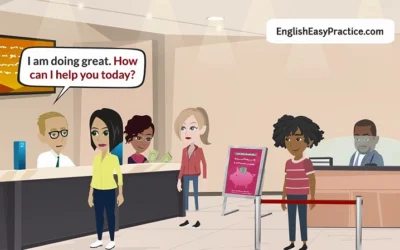
- A real shop conversation: Emma wants a winter jacket, and Tom, the shop assistant, helps her choose.
- Four useful words: thicker, try on, tight and till.
- You’ll learn how to ask for a cheaper option, a bigger size and the fitting room, and how to pay.
- The video takes about 30 minutes, with listening, vocabulary, repeat, answer and shadowing parts.
Have you ever walked into a shop abroad, seen the perfect jacket… and then said nothing, because you weren’t sure how to ask for a different size? You’re not alone. Shopping is one of the first places where learners need English in real life, and one of the places where they feel most nervous.
The good news is that shop conversations are very predictable. The assistant says almost the same things every time, and you need only a handful of sentences. Learn them once, practise them out loud, and you’re ready.
Watch the Lesson
Lesson map: listening (01:57), vocabulary (04:59), listen and repeat (07:14), listen and answer (17:27), shadowing (22:57).
The Conversation: Buying a Winter Jacket
- Tom: Good afternoon. Welcome. Can I help you with anything today?
- Emma: Hi. Yes, please. I am looking for a winter jacket. Do you have anything in this style?
- Tom: Of course, we have several options. Let me show you what we have. This one here is very popular right now. It is warm, light, and very good quality.
- Emma: Oh, I like that one. How much does it cost?
- Tom: This one is $95.
- Emma: Hmm, that is a little expensive for me. Do you have anything a little cheaper?
- Tom: Yes, we do. This one over here is very similar, but it is $65. It is also very warm and good quality.
- Emma: I see. What is the difference between the two jackets?
- Tom: The first one is a little thicker and it has more pockets. The second one is lighter, but it is still very warm for winter.
- Emma: Can I try the second one on?
- Tom: Of course. The fitting rooms are just over there.
- Emma: I love the color, but do you have this in a larger size? This one is a little tight on me.
- Tom: Let me check for you. Yes, we have one left in a large. Here you go.
- Emma: Perfect. This one fits much better. I will take it.
- Tom: Great choice. Would you like to pay by cash or by card?
- Emma: By card, please.
- Tom: No problem. Please follow me to the till. And if you are not happy with it, you can bring it back within 30 days.
- Emma: Oh, that is really good to know. Thank you so much for your help.
- Tom: My pleasure. Enjoy your new jacket.
4 Shopping Words From the Lesson
Thicker
“Thick” means there is a lot of material, so it is heavy and warm. “Thicker” compares two things. The blue coat is thicker, but the red coat is lighter. The opposite is thinner or, for clothes, often lighter.
Try on
To put on clothes to see if they fit before you buy them. Can I try on this jacket, please? Watch the word order with “it”: Can I try it on? (not “try on it”).
Tight
Too small, so it feels uncomfortable. These shoes are tight. They hurt my feet. The opposite is loose or too big. When clothes are just right, we say they fit: This one fits much better.
Till
The place in a shop where you pay. It is common in British English. You will also hear checkout, cash register or simply the counter.
Your Shopping Survival Kit
Here are the sentences from the lesson, grouped by situation. Learn one line from each group and you can handle almost any clothes shop:
- Saying what you want: I’m looking for a winter jacket. / Do you have anything in this style?
- Asking the price: How much does it cost? / How much is this one?
- Asking for something cheaper: That’s a little expensive for me. Do you have anything a little cheaper?
- Comparing: What’s the difference between these two?
- Trying on: Can I try it on? / Where are the fitting rooms?
- Size problems: Do you have this in a larger size? / It’s a little tight on me.
- Deciding: This one fits much better. I’ll take it.
- Paying: By card, please. / Can I pay in cash?
Did you notice how polite Emma is without being formal? Words like a little make a complaint softer: “a little expensive”, “a little tight”. Native speakers do this all the time. For more small phrases like this, see 10 real English phrases native speakers use every day.
Practise Like You’re Really in the Shop
In the listen-and-answer part, you will hear questions such as “Did Emma pay in cash?” and “What was the difference between the two jackets?” Answer out loud, in a full sentence if you can. Then, in the shadowing part, take Emma’s role.
A fun extra step: next time you are in a shop in your own country, say Emma’s lines quietly in your head. “Do you have this in a larger size?” It sounds silly, but it connects the English to a real place, and that is what makes it stick.
Shopping is just one everyday situation. For another one, try our conversation about talking about your ambitions in English, or our older lesson on everyday English conversations.
Want More Real-Life Conversations?
The Shadowing English Speaking Course includes 60 everyday conversations, including shopping situations, as MP3 audio and PDF text. You can download a free sample lesson first.
Frequently Asked Questions
How do I ask for a different size in English?
Say “Do you have this in a larger size?” or “Do you have this in a medium?” If it’s too big, ask for “a smaller size”.
Is it “try on it” or “try it on”?
“Try it on.” With “it” or “them”, the small word goes in the middle: “Can I try it on?” With a noun, both are fine: “try on the jacket” or “try the jacket on”.
What is a till?
The place where you pay in a shop. It is common in British English. Americans usually say “checkout” or “cash register”.
How do I ask for a cheaper option politely?
“That’s a little expensive for me. Do you have anything a little cheaper?” The words “a little” make your sentence softer and more polite.